Eu·lep·tos
Already have Claude Code installed? You're done — Euleptos wraps it directly. No API key, no extra auth, no configuration. Your conversations, artifacts, and context live as real files on your disk. Klein3 cognitive primer baked in. Optional Ollama auto-install if you want local models too.
~/euleptos, sets up Python deps, detects your Claude Code install (uses it directly — no API key needed). Does not install Ollama unless you ask.
Want Ollama too? (local models, ~2 GB download)
llama3.2:3b as a baseline. If Ollama is already installed, Euleptos just uses it — no re-install, no surprise pull. read the script.
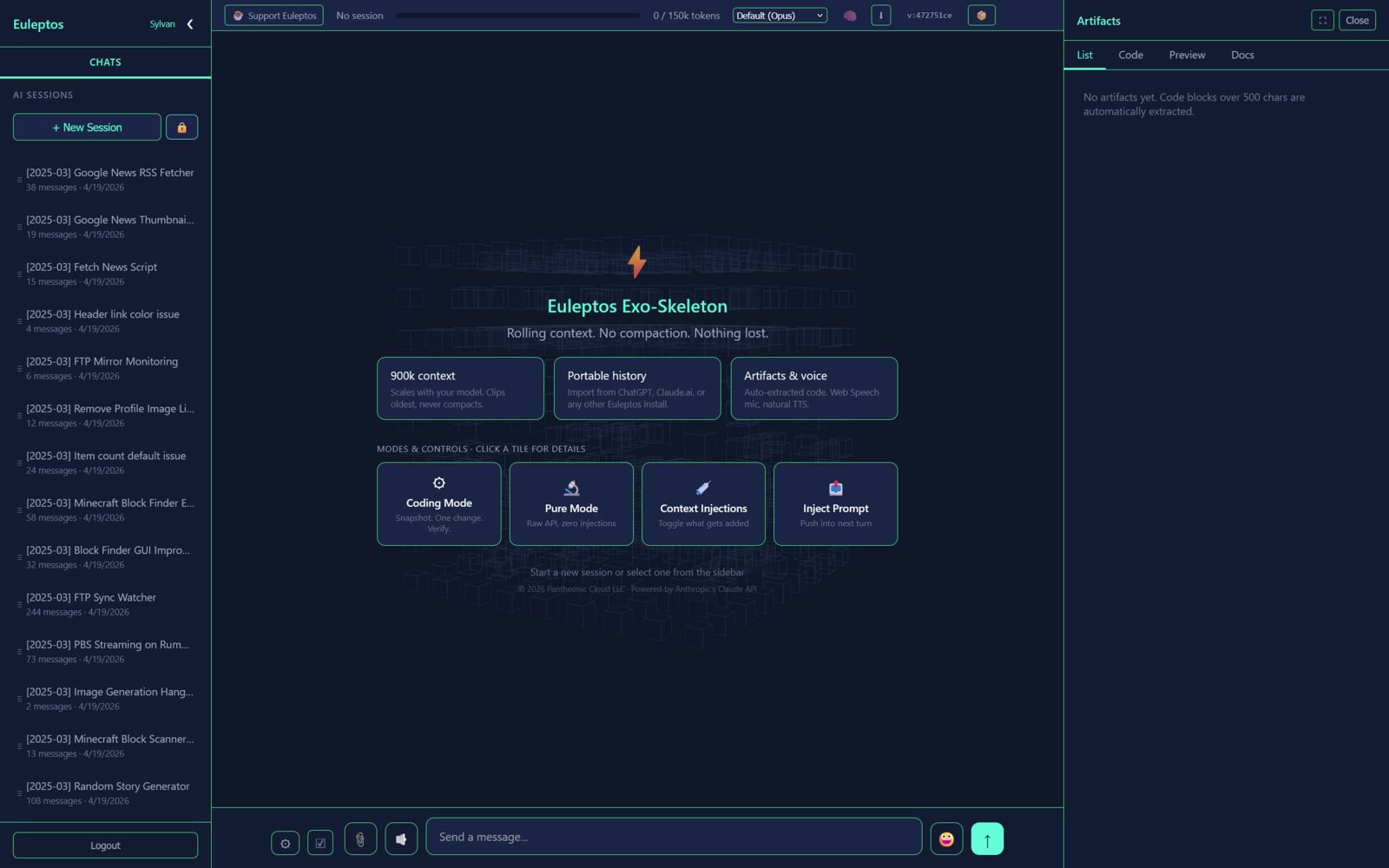
What the installer sets up
claude is on your PATH, Euleptos will drive it directly via claude -p. No API key needed. Your existing Claude Code login is the auth. If Claude Code isn't installed, you'll get a one-line pointer to Anthropic's installer.
--ollama (or $env:EULEPTOS_WITH_OLLAMA=1 on Windows), the installer runs the official Ollama setup and pulls llama3.2:3b as a baseline (~2 GB). Otherwise the installer leaves Ollama alone — you can add it any time later.
What you get
No API key needed
Euleptos drives your existing Claude Code install via claude -p. Whatever auth you've already set up for Claude Code is the auth for the harness. Zero extra steps.
Local-first
Sessions, artifacts, and notes live on your disk. No telemetry, no cloud sync, nothing leaves your machine except the calls you make to Claude or Ollama.
Ollama auto-detect
Local models on localhost:11434 show up in the model picker as ollama:<name>. Switch between Claude and local with one click.
Klein3 primer
Triple-pass cognition (direct → invert → combine), superposition of hypotheses, witness/solver separation. 57 controlled trials picked the components that actually shape behavior.
Artifacts as files
When the model produces code, docs, or assets, they go to disk as real files you can grep, edit, version. Not chat-bubbles you have to copy out.
Hash-based updates
Manifest of per-file hashes. Update notifier shows exactly which files changed. Trust matters for tools you run on your own box.
Open source, MIT
Read every line. The installer is a single bash script you can vet before piping it. View on GitHub.
The research
The Klein3 primer baked into the harness isn't vibes — it's the survivor of a controlled study across 18 primer conditions and 8 task types. We killed 60% of our own prompt stack, including a 285-token block that turned out to do nothing. The methodology, instrument, full findings, and all raw trial data are public.
The framework behind it
Akataleptos is the research — a recursive theory of everything from a Menger sponge fractal. Euleptos is the well-grasped instance: the tool you can hold. Framework names the truth; tool names the grasping. Read the framework at akataleptos.com.